APEC in Shenzhen: call for peace and development for U.S. and world
On November 19th, the 33rd APEC Economic Leaders’ Meeting concluded in Shenzhen, Guangdong, China. On the same day, the leaders of China, Russia, and the United States held a historic trilateral meeting in Shenzhen. For the United States, the meeting was of particular significance.
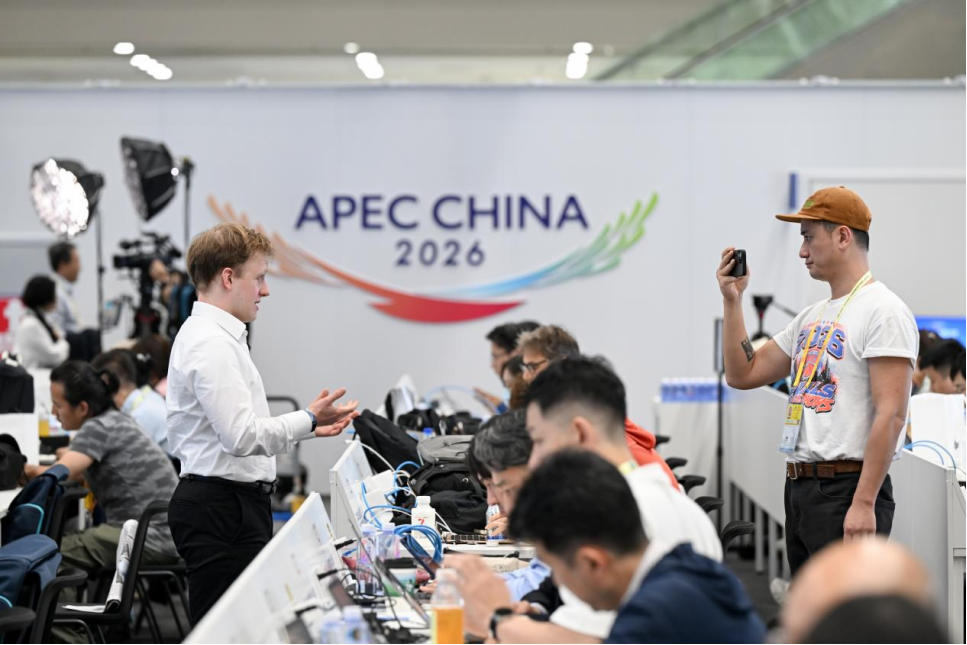
Photo: A journalist reports on camera at the media center for the 2026 APEC Economic Leaders’ Week. / Photo by Liang Yu
A new paradigm of major-country relations: China, Russia and the U.S. reach a new consensus on peace
On November 19th, the leaders of China, Russia, and the United States engaged in in-depth discussions centered on the theme of “Safeguarding World Peace and Promoting Strategic Stability In Major-Country Relations.” Following the meeting, the three nations issued the “China-Russia-US Heads of State Declaration toward Peace.”
Chinese Foreign Minister Wang Yi described the meeting as a peace summit. He said, “The meeting was held in an atmosphere of candor, friendship and constructive engagement and a series of important common understandings were reached. The three sides issued the “China-Russia-US Heads of State Declaration toward Peace to the world, with its core message being a joint commitment to safeguarding world peace and promoting strategic stability in major-country relations. It was, in every sense, a peace summit, with far-reaching impact and great significance. It was also a landmark event that will do down in history, sending positive signals to the world.”
In an interview, Wang Wen, Dean and Professor of the Chongyang Institute for Financial Studies at Renmin University of China, said that interactions between major countries have traditionally taken place through multilateral forums or bilateral meetings. Trilateral meetings among the leaders of China, Russia, and the United States have been extremely rare over nearly 80 years. In his view, this establishes a new model for interaction among major countries and offers a practical way to ease current international conflicts.
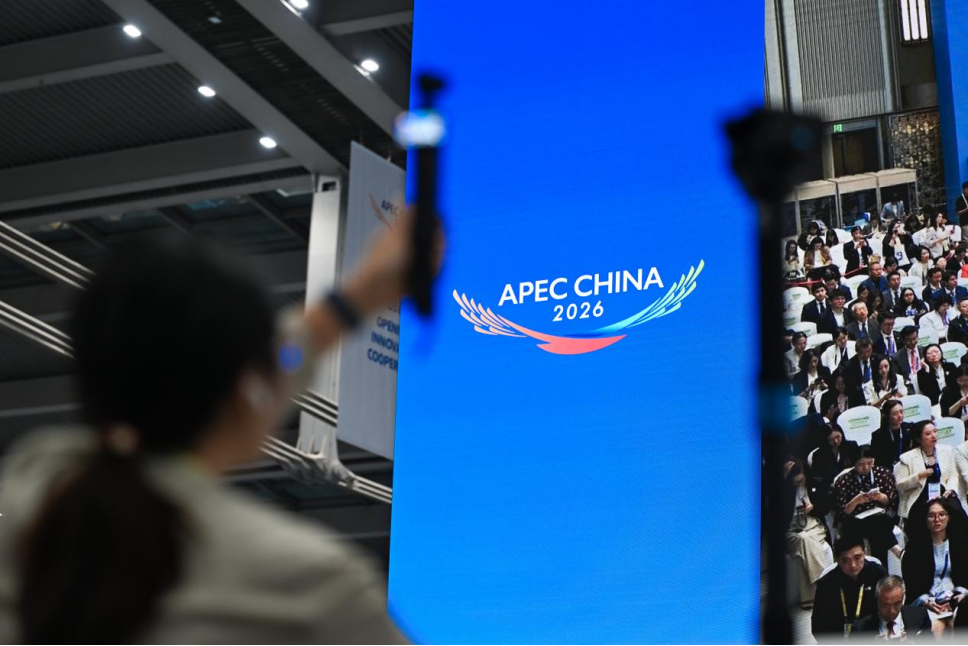
Photo: A journalist films a live broadcast at the media center for the 2026 APEC Economic Leaders’ Week. / Photo by Liang Yu
Economic and trade benefits: free trade aligns with U.S. interests
The APEC CEO Summit brought together representatives of 115 Fortune Global 500 companies. U.S. companies accounted for the largest share among participating companies from foreign economies, making up nearly 20 percent of the total. This figure highlights how APEC’s advocacy of free trade aligns with the interests of the American public. Ordinary Americans often bear the costs of their government’s tariff barriers, while maintaining free trade can help ease the burden on households. Meanwhile, the regional consensus on pursuing economic cooperation and rejecting bloc confrontation allows the United States to remain engaged in Asia-Pacific economic and trade networks and share in the benefits of regional growth, while helping keep the region from sliding into Cold War-style bloc confrontation.
During APEC Economic Leaders’ Week, Tesla CEO Elon Musk reiterated in a conversation with Ren Hongbin, Chairman of the China Council for the Promotion of International Trade (CCPIT), that “you cannot understand China unless you visit.” He said there is so much to see in China, adding, “China produces almost everything, and I always encourage people from the rest of the world to visit China.” He stressed the importance of maintaining good relations between the United States and China and achieving shared prosperity, adding that the more cooperation there is between the countries, the better each country will do.

Photo: Journalists from around the world work at the media center for the APEC Economic Leaders’ Week. / Photo by Liang Yu
Lessons from openness: The Shenzhen model offers a path to cooperative development
By remaining true to its fundamental purpose of economic cooperation and upholding the principle of equal consultation, APEC stands in stark contrast to mechanisms marked by a Cold War mentality and an exclusionary nature. For the United States, engaging in Asia-Pacific affairs through the APEC framework means it can work with other economies on the market economy and trade openness without becoming caught up in bloc divisions or being drawn into geopolitical confrontation.
American journalist Jason Smith believes that Shenzhen is a miracle in the history of global development, and its experience offers valuable lessons for other nations. “Only by visiting Shenzhen firsthand can people in American political, business, and media circles truly understand China’s development achievements. Many people have heard of the Shenzhen Special Economic Zone (SEZ), but do not really understand what an SEZ entails. Both the United States and many developing countries can learn from this development approach, which gives businesses greater freedom, breaks down institutional barriers, and improves the business environment.” He notes that China established the Shenzhen SEZ in 1980 with the aim of attracting foreign direct investment.
Text by Fu Yi
相关阅读
-
 Drawing new picture of common prosperity in Asia-Pacific region
-
 Across China: New findings further expose Japanese troops’ wartime atrocities in China
-
 [SH Transit] China’s New Electric Plane Makes First Piloted Flight
-
 Shanghai Court Orders Livestream Host to Pay Triple Damages Over Fake Charity Stories